
What Does Google Ad Grants Management Actually Cost?
October 13, 2026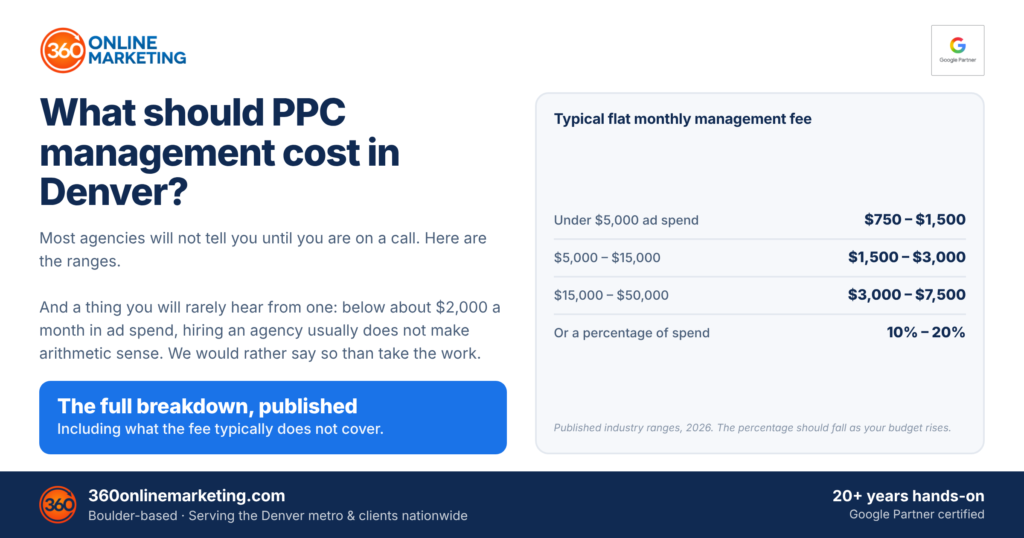
Almost nobody in this industry publishes rates, which is why you’re reading this. Here are the actual numbers, how each pricing model behaves once you’re inside it, and the case for not hiring anyone at all.
The three PPC models you’ll be quoted:
Percentage of ad spend — Usually 10% to 20%. Above roughly $20,000 a month in spend, 12% to 15% is typical. The argument for it is alignment: the agency earns more as you spend more and, in theory, as you grow. The argument against is the same sentence read uncharitably, because an agency on percentage has a standing incentive to recommend a bigger budget. That isn’t necessarily dishonest — more budget often genuinely is the right call — but you should notice that you’re taking budget advice from someone paid on budget.
Flat monthly retainer — $1,500 to $10,000+, with most agency retainers starting around $1,000 to $1,500. Predictable, which matters when you’re forecasting. The weakness shows up when the account needs a real overhaul and the agency hasn’t allocated hours for it; then you’re quoted a project fee on top, or the overhaul quietly doesn’t happen.
Hybrid — A base fee plus a smaller percentage. Generally the most sensible structure for mid-sized accounts. The base covers tooling, reporting and the floor of work that exists whether or not you’re spending; the percentage scales with the budget. It also protects both sides if you pause spend for a season.
You’ll occasionally be offered performance-based pricing. I’d be cautious. It sounds like perfect alignment, but it typically requires handing over control of ads, landing pages and funnel, and the agency’s share of upside is large. It fits some affiliate and ecommerce setups and very few local service businesses.
Hourly exists too — Roughly $150 to $500 for strategy consultation, $100 to $150 for an experienced media buyer. It’s the right shape for a one-off audit or fixing a specific tracking problem for an in-house team, and the wrong shape for ongoing management, since nobody wants to itemize fifteen minutes of bid adjustments.
What flat fees look like by spend:
| Monthly ad spend | Typical management fee |
|—|—|
| Under $5,000 | $750 – $1,500 |
| $5,000 – $15,000 | $1,500 – $3,000 |
| $15,000 – $50,000 | $3,000 – $7,500 |
| $50,000 – $100,000 | $7,500 – $12,000 |
| $100,000 – $250,000 | $10,000 – $20,000 |
Notice the percentage falls as budgets rise. That’s correct and you should expect it — a $100,000 account does not require ten times the manual work of a $10,000 one. If an agency holds a flat 15% from $5,000 all the way to $100,000, ask why.
One-time fees you’ll also encounter: Account audit $500 to $3,000, campaign build $1,000 to $5,000+, conversion tracking setup $500 to $3,000, landing page design $1,500 to $7,500+.
What this costs in Denver specifically
National ranges only get you so far, because what you pay in fees matters far less than what you pay per click — and that varies enormously by category.
From accounts I manage in this market: a Denver-area emergency home services advertiser runs an average CPC around $27. Legal and insurance run higher. Across a broader portfolio spanning fourteen accounts and several industries, the blended average is $2.29, with a blended cost per conversion of $59. Those three numbers are all real and all from live accounts, and the spread between them is the point — “what does PPC cost in Denver” has no single answer, and anyone who gives you one without asking what you sell is guessing.
The practical consequence: in a $27-per-click category, a $2,000 monthly budget buys roughly 74 clicks. If your site converts at 5%, that’s three or four leads. Before management fees. Which brings us to the part most agencies won’t lead with.
When you shouldn’t hire an agency
Under about $2,000 a month in ad spend, agency management rarely makes arithmetic sense. A $1,000 fee on a $2,000 budget means a third of your money is going to management before a single click. At that level you want a freelancer, a few hours of paid setup from someone competent, or to run it yourself with a quarterly review.
Between $2,000 and $5,000, it depends almost entirely on your cost per lead and what a customer is worth. High-ticket categories justify it early; low-margin ones don’t.
Above about $5,000, agency management usually pays for itself, because at that spend the waste a competent manager eliminates generally exceeds the fee.
And a warning on the other end: retainers under roughly $500 a month are, with rare exceptions, automated management. Scripts, rules, a dashboard and a monthly PDF. That’s not fraud — it’s a real business model and it’s better than nothing — but it isn’t a person thinking about your account, and you shouldn’t buy it believing otherwise.
What the fee usually doesn’t cover
The retainer is rarely the whole cost, and the gaps are predictable enough that you can ask about them directly before signing.
Landing pages. Most management fees cover campaigns, not the pages people land on — which is awkward, because the landing page frequently matters more to your cost per lead than anything happening inside the ad account. If your site converts at 2% and a competitor’s at 6%, they can pay three times your click price and still win. Expect a separate build fee, or an agency that will tell you honestly that fixing the page comes before touching the campaigns.
Creative. Display and Performance Max need images and sometimes video. Some agencies produce these, some expect you to supply them, and some quietly let Google auto-generate them, which is how you end up with assets you’ve never seen running under your brand name.
Call tracking. Usually a third-party subscription billed to you, often $30 to $100+ a month depending on volume. Worth every cent in a phone-driven category, but it’s a line item, not an inclusion.
Conversion tracking setup. If it doesn’t already exist, is commonly a one-off fee rather than part of onboarding.
None of these are unreasonable charges. They become a problem only when they surface after you’ve budgeted for the retainer alone, so get them on the table in the first conversation.
The number that actually decides this
Fees are the most visible variable and close to the least important. What decides whether PPC works for you is cost per acquired customer against what a customer is worth over their lifetime. An agency charging $3,000 that brings customers in at $200 each is cheap. One charging $800 that brings them in at $900 each is expensive, and the invoice won’t tell you which you have.
Which means the questions worth asking in a sales conversation aren’t about price:
“How is conversion tracking set up, and what counts as a conversion?” If the answer is vague, nothing downstream works. Modern Google Ads bidding optimizes toward whatever you’ve told it to value, so a loose definition — counting every form view, every three-second phone click — produces efficient delivery of junk. This is now the highest-leverage thing in most accounts, and it’s unglamorous enough that it’s often skipped.
“Show me a search terms report from a comparable account.” Not the keyword list. The actual queries that triggered ads. Match types don’t mean what they used to, and this is where waste lives.
“What’s in Performance Max, and can you show me the channel breakdown?” If a large share of spend sits inside PMax and nobody can tell you where it went, that’s worth resolving before you sign.
“Who is actually in my account?” At volume agencies, accounts are frequently run by junior staff working a checklist across dozens of clients. Worth knowing, because an increasingly automated platform punishes inattention faster than the old one did.
What I’d tell a Denver business owner
If you’re spending under $2,000 a month, don’t hire an agency — pay someone good for a proper setup and a quarterly review, and run it yourself in between.
If you’re spending $2,000 to $10,000, expect $750 to $3,000 a month depending on complexity, and weight your decision toward who’s doing the work rather than what the retainer says. At this size the difference between a good manager and an average one is larger than any plausible fee difference.
Above $10,000, percentage or hybrid pricing is normal and reasonable, and you should expect the percentage to come down as you scale.
And whatever you’re paying now: pull your own search terms report for the last thirty days and read what you actually bought. That costs nothing, takes two minutes, and tells you more about whether your current arrangement is working than any proposal will.
—
I’m a one-person shop in Boulder working with businesses across Denver and the Front Range. When you hire me, I’m the person in your account. If you want a straight read on what’s happening in your PPC account(s), I’ll do the search terms review and tell you what I find, whether or not it leads anywhere. Learn more about my PPC management and Google Ads management services, or if you’re up this way, the Boulder PPC side of things. Or just get in touch.
—
Sources for the figures used above
– Pricing models, flat-fee tiers by spend, hourly rates and one-time fee ranges: New Media, “PPC Management Pricing in 2026: Real Numbers From an Agency Owner”
– CPC and cost-per-conversion figures: live Google Ads accounts under my management, all-time data through 2026
Note to self before publishing: the Denver CPC figures are the strongest thing in this post and the only part no competitor can copy. Double-check the $27 emergency-services average and the $2.29 / $59 blended figures against the current exports before this goes live, and consider whether you’re comfortable with that level of specificity — it’s anonymized by category, but it is real client data. If you’d rather soften it, “high-urgency home services routinely run north of $25 a click in this market” carries most of the weight with less exposure.