
Is Microsoft Advertising Worth It for a Denver Business?
September 14, 2026
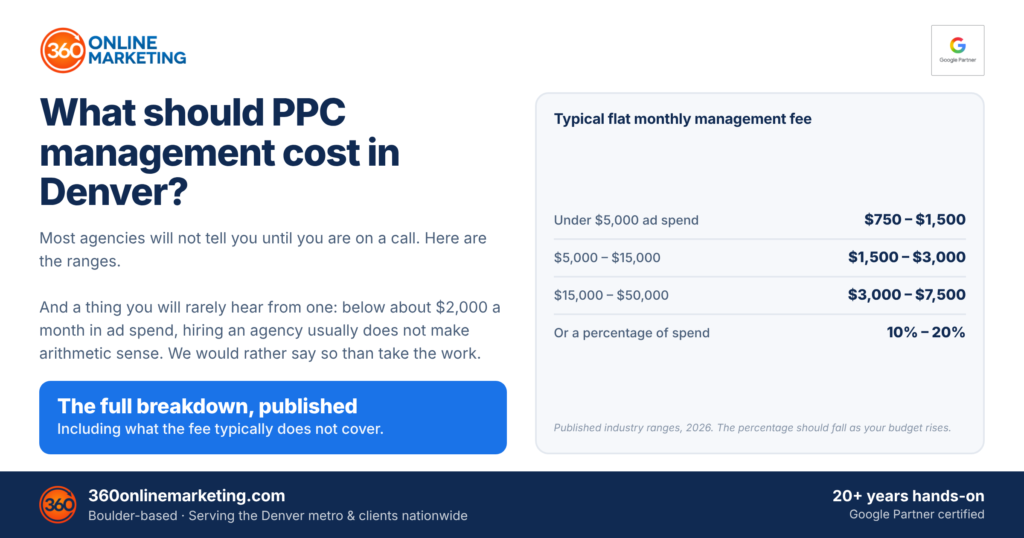
What Should PPC Management Cost in Denver?
October 22, 2026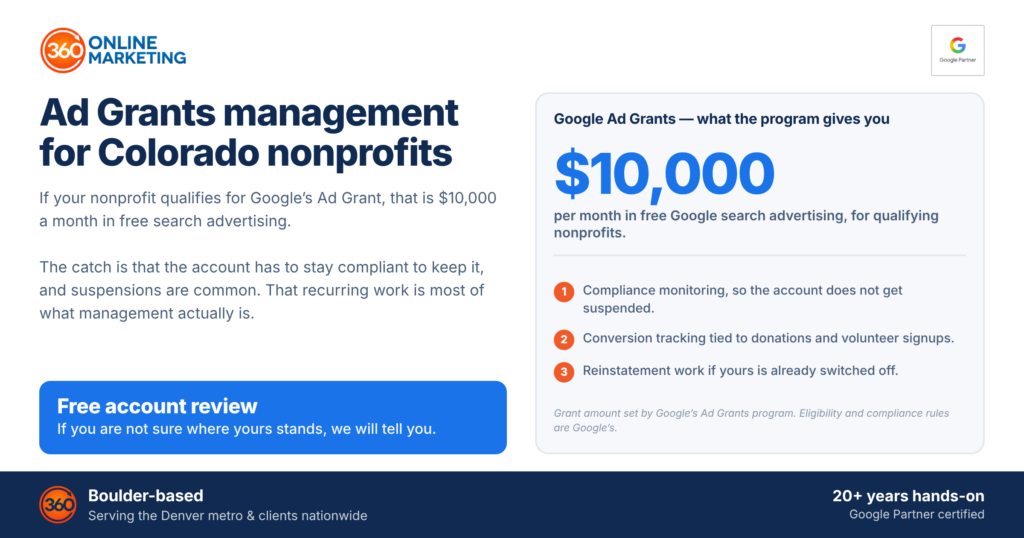
Nonprofits ask me this and get a vague answer, which is odd given that most of the agencies doing this work publish their rates. So here are the actual numbers, and then the thing I’d rather you asked instead.
The short answer:
Agencies that publish pricing for Google Ad Grants management generally land between $400 and $1,750 per month. Published tiers cluster around $400, $499, $600, $899, $1,200, $1,497 and $1,750. Plenty of firms don’t publish at all and quote on a call, which usually means they’re sizing you up rather than hiding something.
Setup fees range from nothing to about $2,000, with $500 to $2,000 the common band. Some waive it in exchange for a twelve-month commitment.
You’ll also see a few pricing models in the wild:
Flat monthly tiers — the most common, and the most sensible for grant work.
- Monthly fee plus one-time setup — reasonable if the account is being built from scratch or recovering from suspension.
- Bundles — grant management packaged with hosting, local SEO or web work. Fine if you want those things, a way to obscure the real rate if you don’t.
- Percentage of ad spend, usually 15–20% — and this one I’d push back on. The grant isn’t your money. Charging you a percentage of free advertising inventory bills you more for the agency spending more, which is the wrong incentive in a program where spending more is trivially easy and spending well is not.
What you actually get at each level – Roughly, and with a lot of overlap between firms:
Under $400 buys campaign setup and maintenance, keyword monitoring, basic compliance checks, monthly or quarterly reporting, and limited ad copy updates. - $400 to $800 adds ongoing keyword research, ad copy testing, landing page recommendations, conversion tracking, negative keyword management and regular strategy calls.
- $800 to $2,000+ adds custom landing pages, CRM integration, a dedicated account manager, weekly reporting and coordination with your other channels.
The question I’d rather you asked:
Every agency selling Ad Grants management eventually makes the same pitch: “The grant is worth $10,000 a month, our fee is $600, look at the return”.
It’s a good-sounding argument and it’s mostly wrong, because it treats the $10,000 as money.
It isn’t. It’s a credit line for Google search ads with a long list of restrictions attached, and it has no value whatsoever until it produces something your organization actually needed — a donation, a volunteer signup, a program application, someone finding a service they didn’t know existed. A grant account that spends the full $10,000 on traffic that bounces has achieved nothing. It has just moved a number.
I mention this because “we’ll help you use the full $10,000” is the industry’s favorite promise, and using the full $10,000 is one of the easiest things in paid search to do badly. Broad keywords, loose match types and automated bidding will exhaust that budget without difficulty. Whether any of it reached someone who cares about your mission is a separate question that the spend number cannot answer.
So the figure to ask about isn’t the fee and isn’t the spend. It’s cost per meaningful conversion — and whether the person quoting you can define what a meaningful conversion is for an organization like yours before you’ve explained it to them.
Why the work costs what it costs:
Ad Grants accounts are more constrained than paid accounts, not less, and that’s where the hours go. The program’s published requirements include:
A 5% click-through rate floor, checked monthly. Fall below it repeatedly and the account can be suspended - A $2.00 maximum CPC on manual bidding — though Smart Bidding strategies like Maximize Conversions are exempt, which is why nearly every well-run grant account uses them
Conversion tracking is mandatory, with at least one meaningful conversion action in place
No single-word keywords outside Google’s approved exception list, and no overly generic ones
Keywords sitting at Quality Score 1 or 2 must be paused or removed
Geographic targeting on every campaign
At least two ad groups per campaign, two ads per ad group, and two sitelink extensions at account level
The practical effect is that a grant account needs genuine monthly attention. A paid account that drifts for a month costs you some wasted spend. A grant account that drifts below 5% CTR for a couple of months gets suspended, and getting reinstated means an appeal, documented fixes, and potentially weeks without the grant running at all. That recurring compliance work is most of what you’re paying for, and it’s why “set it up and leave it” doesn’t survive contact with the program.
What it looks like over a year:
Monthly figures understate the decision, because the first year carries the setup cost and the ongoing years don’t.
A typical first year at the middle of the market runs roughly $7,200 to $12,800 — a $600 to $900 monthly fee across twelve months, plus a setup fee somewhere between $0 and $2,000 depending on whether the account exists, whether it’s compliant, and whether it’s currently suspended. Year two and beyond drop to the monthly figure alone, so $7,200 to $10,800.
At the cheaper end you’re looking at about $4,800 a year with no setup fee. At the managed-service end, $18,000 to $20,000 plus setup.
Two things worth weighing against those numbers. First, this is a real recurring cost against a grant that produces nothing if the account is suspended — so the money buys continuity as much as optimization. Second, if your board is evaluating this, the honest framing isn’t “we get $120,000 of free advertising for $9,000.” It’s “we expect the grant to generate roughly N donations, volunteers or program signups a year, and this is what it costs to produce them.” If you can’t fill in N with a defensible number after three or four months of data, that’s the conversation to have before renewing.
When you shouldn’t hire anyone:
If your organization has someone who already understands Google Ads and can give the account a few focused hours a month, you may not need an agency. The grant is free, the management doesn’t have to be, and a competent internal person who knows your programs and your language has a real advantage over an outside firm learning both.
Where that breaks down is consistency. The failure mode I see isn’t incompetence, it’s a capable staff member who gets busy for two months during a campaign push, the CTR slides, and nobody notices until the suspension notice arrives. If the work can’t be reliably protected on someone’s calendar, paying for it is cheaper than losing the grant.
The other honest case against hiring: if your organization is small enough that $500 a month is a meaningful share of your budget, and the grant would realistically drive a handful of conversions a month, the arithmetic may simply not work. Any agency willing to tell you that is worth talking to.
What to ask before you sign:
“What will you count as a conversion, and how will you track it?” If this is vague, nothing built on top of it will work. Ad Grants bidding optimizes toward whatever you define, so a bad definition produces efficient delivery of the wrong thing.
“Show me a search terms report from a grant account you manage.” Not the keyword list — the actual queries that triggered ads. This is where you see whether someone is managing the account or letting it run.
“What happens if we’re suspended?” You want to hear a specific process, not reassurance that it won’t happen.
“Who will be in the account?” At agencies built on volume, grant accounts are frequently handled by junior staff working a checklist across dozens of clients. That’s a business model, not a scandal, but it’s worth knowing — and it’s the gap between a $400 plan and a $1,500 one more often than any feature list.
The honest summary
Most nonprofits should expect to pay somewhere between $500 and $900 a month for competent Google Ad Grants management, plus a setup fee if the account needs building or rescuing. Below $400, you’re generally buying automated maintenance. Above $1,500, you should be getting landing pages, integration work and strategic attention — and if you’re not, you’re paying for an account manager’s calendar rather than results.
But the fee is the least interesting number in the conversation. A $400 agency that gets you 40 qualified conversions a month is better than a $1,500 agency that gets you 15, and neither the price list nor the spend report will tell you which you’ve hired. Only the conversion data will, which is why it’s the first thing to insist on.
I manage Google Ad Grants accounts for Colorado nonprofits, and I’m the person who’ll be in your account — not a junior account manager working through forty of them. If you want a straight read on whether your current account is compliant and what it’s actually producing, I’ll do that review and tell you what I find either way. You can see how I approach Google Ad Grants management, read more about PPC management generally, or get in touch.